


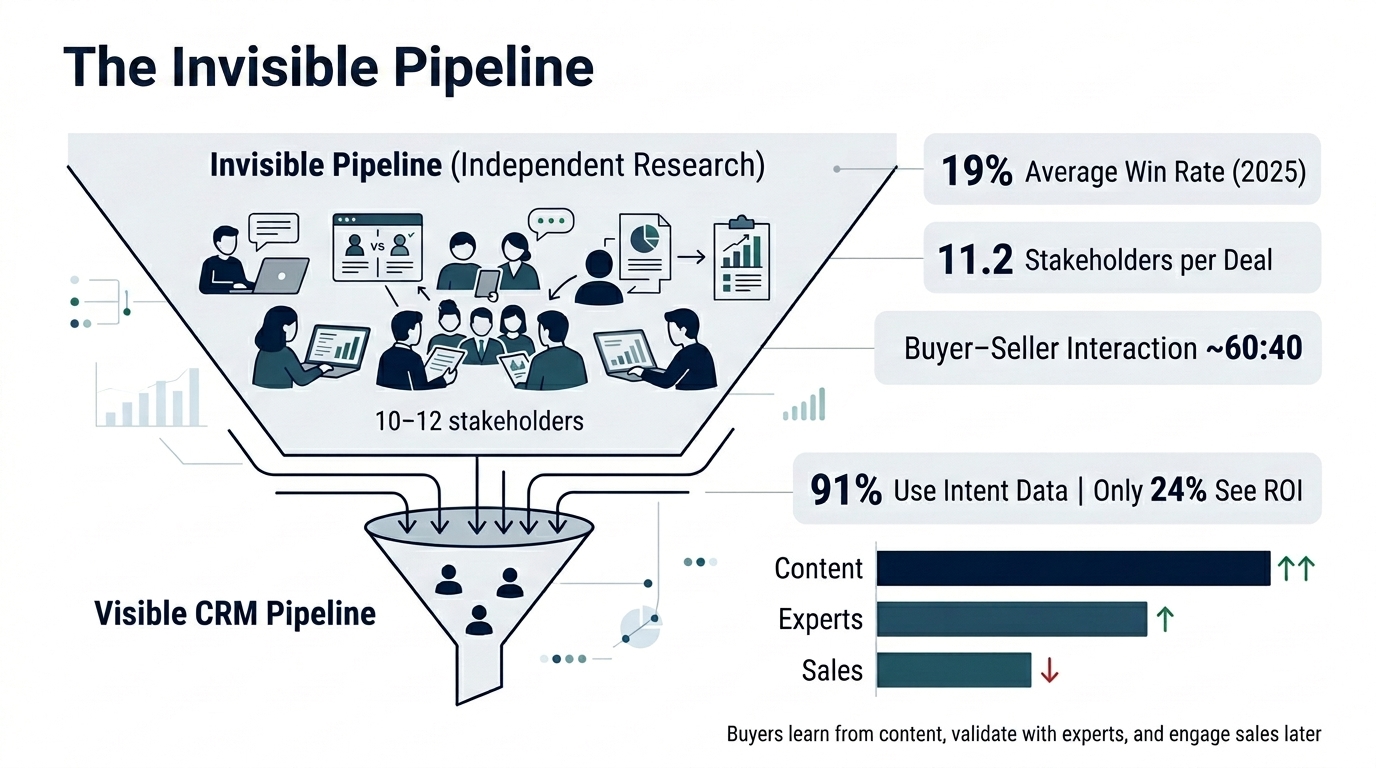
Sales budgets are up. Pipeline programs are more sophisticated than ever. And yet, the average B2B win rate dropped to just 19% in 2025 — down from 29% only a year earlier, according to Ebsta's annual pipeline analysis. That's not a minor correction. That's a structural problem.
The uncomfortable explanation: most revenue teams are optimizing the wrong part of the funnel. They're investing in discovery calls, demo sequences, and proposal templates — activities that happen after a buyer has already made up their mind. The research is unambiguous. According to 6sense's 2025 Buyer Experience Report, the vendor buyers prefer before their first seller interaction wins 80% of deals. By the time a lead converts in your CRM, the competitive battle is often already over.
Revenue intelligence changes the game by moving engagement upstream. But the gap between adopting the tools and extracting real value from them is wider than most teams expect.
The Invisible Pipeline Problem
The traditional B2B sales funnel assumes a relatively linear progression: awareness, interest, consideration, decision. Revenue teams build their motions around that logic — nurture sequences, SDR outreach cadences, and MQL scoring models all presume they can shape the buyer's journey.
The reality is messier. Buying committees now average 11.2 stakeholders for deals over $50K (Landbase, 2026), and those stakeholders are conducting the majority of their research independently, well before engaging a vendor. The buyer-seller interaction ratio has shifted from a 70/30 split (independent research vs. seller engagement) to 60/40 — still heavily weighted toward self-directed research.
What does that mean in practice? Revenue teams are frequently responding to opportunities rather than shaping them. Their pipeline reflects accounts that have already narrowed their shortlist — not the full universe of accounts that could be influenced. This creates a structural ceiling on win rates that quota attainment fixes and sales training can't break through.
Why Intent Data Adoption Isn't Translating to Results
Intent data was supposed to solve this. If teams can see which accounts are actively researching relevant topics, they can front-run the competition — reaching buyers during the research phase rather than after the shortlist is set.
The adoption numbers support the premise. A 2026 industry survey found that 91% of B2B marketers now use intent data to prioritize accounts. But here's the catch: only 24% of those teams report exceptional ROI from their intent data investment.
That's a massive value gap. The majority of teams have the data but not the result.
The reasons are consistent across RevOps post-mortems:
Signal overload without prioritization. Raw intent data produces too many "in-market" signals to act on meaningfully. Without account scoring models that weight signals by fit, timing, and buying stage, SDRs end up chasing noise.
Siloed tooling. Intent data lives in one platform. CRM records live in another. Campaign data is in a third. When signals don't flow across the stack automatically, they get acted on inconsistently — or not at all.
Reactive sequencing. Many teams treat intent signals like a better form of lead scoring — a trigger for the same outbound sequence they'd have run anyway, just with slightly more targeting. That misses the real opportunity, which is to serve a buyer the right content at the stage of research they're actually in.
What High-Win-Rate Teams Do Differently
The teams bucking the 19% median share a few operational patterns worth examining.
They map intent signals to buying stages, not just personas. Rather than treating all in-market signals equally, they distinguish between early-stage research behavior (competitive comparisons, category education) and late-stage signals (pricing page visits, integration lookups, customer case studies). The engagement play for each is completely different.
They align marketing and sales on account-level engagement thresholds. ABM-oriented programs that use buyer signals to coordinate outreach generate 41% higher win rates and 33% larger average deal sizes compared to broad-reach demand gen, according to industry data compiled by Gradient.works. That uplift comes from coordination — marketing warms the account while sales sequences activate at the right moment.
They instrument the dark funnel. Third-party intent data captures some in-market behavior, but first-party signals — website visits, content downloads, product pages, demo request page visits — are both more reliable and more actionable. High-performing revenue teams build their scoring models on first-party signals first, using third-party intent to extend visibility into accounts not yet on the radar.
They close the loop on win/loss data. Revenue intelligence isn't just about identifying buyers — it's about learning why deals are won and lost. Teams that systematically capture and analyze win/loss patterns identify the precise signals that precede competitive losses, allowing them to intervene earlier in the next cycle.
Building a Revenue Intelligence Stack That Actually Moves the Needle
The tools are not the strategy. That framing matters because the market is full of revenue intelligence platforms promising transformational win rate improvements — and the 24% exceptional-ROI stat suggests most deployments don't deliver on that promise.
An effective revenue intelligence layer requires four components working in sequence:
Deploying intent data without the scoring layer produces noise. Deploying scoring without activation routing produces reports that nobody acts on. The ROI gap in most deployments traces back to incompleteness — the team has one or two of these components but not all four.
When the full loop is operational, the results are material. 6sense customers in 2025 reported outcomes including 4x higher win rates, 27% faster sales cycles, and deal sizes 46% larger than baseline — outcomes that require both better targeting and better timing to achieve simultaneously.
The Window for Influence Is Narrowing
The uncomfortable corollary to all of this: the window for revenue intelligence to make a difference is getting shorter. Buying cycles are compressing even as they involve more stakeholders. Buyers are arriving at vendor conversations with more formed opinions than ever before. The gap between "account becomes in-market" and "shortlist is finalized" is measured in days for some deal types, not months.
Teams that build revenue intelligence into their operating model — not as a bolt-on capability, but as a core component of how pipeline is generated and managed — are the ones that will sustain win rates while competitors watch theirs erode.
The 19% average is a floor, not a ceiling. But closing the gap requires engaging buyers where the deal is actually being won: before the first discovery call.
Ready to build a revenue intelligence motion that improves win rates before pipeline even reaches your CRM? Book a RevOps audit with Ryvr to identify where your buyer signals are going unactioned — and what it's costing your close rate.
Sources: Ebsta 2025 Pipeline Analysis; 6sense 2025 Buyer Experience Report; Landbase B2B Sales Statistics 2026; Gradient.works 2025 B2B Sales Performance Benchmarks; 6sense Breakthrough 2025 customer outcomes.

